5 Things to Consider While Selecting the Right Inverter Battery
Introduction
Inverters and inverter batteries are an integral part of our eco-system and lifestyle these days. They are a great source of providing uninterrupted power supply to many households. All the appliances and equipment can perform well with this unlimited source of power in the house. While buying an inverter battery, one must be very diligent and informative about its features.
Points to Consider when Purchasing an Inverter Battery
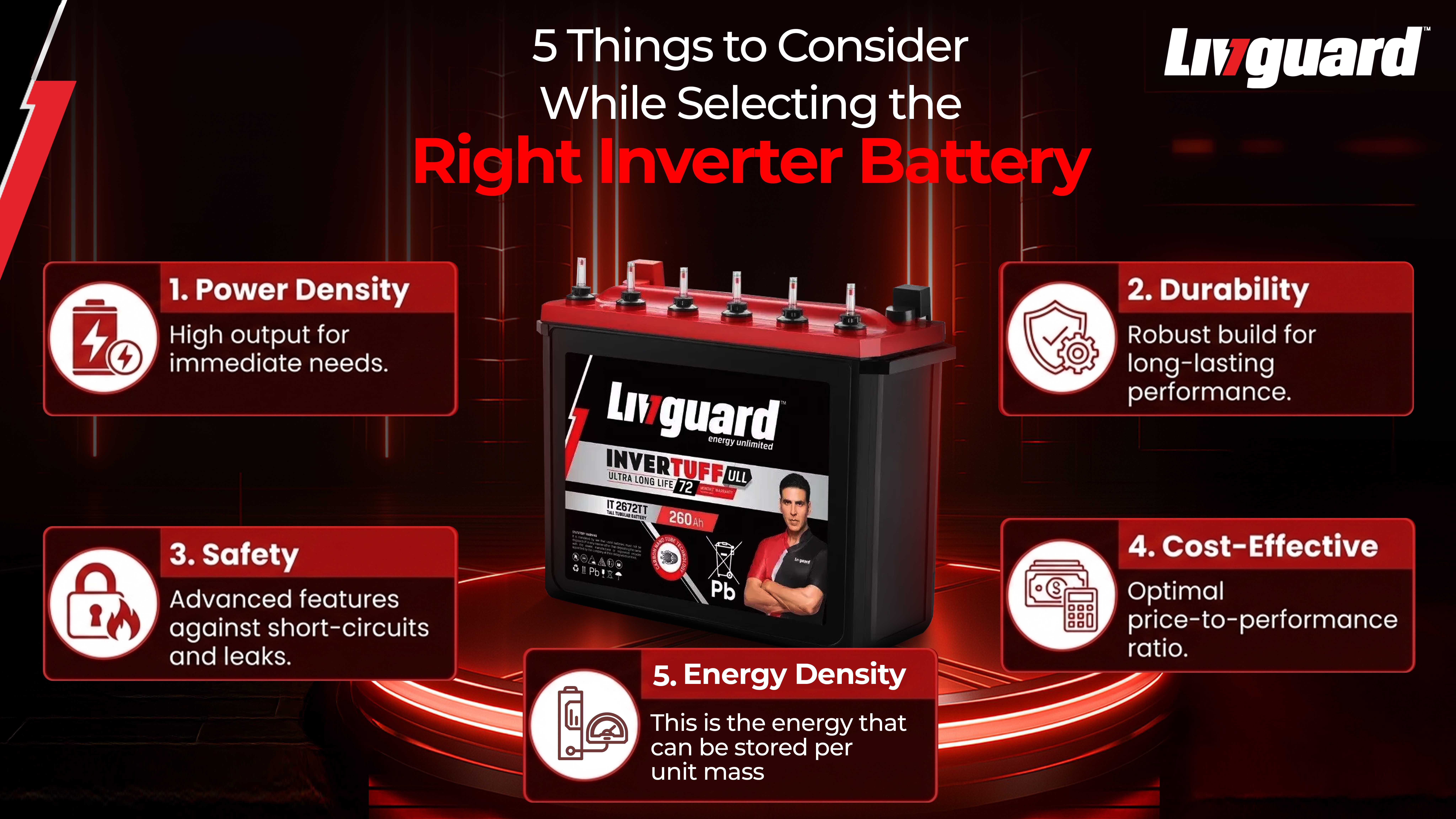
Power Density:
It is the maximum rate of energy discharged per unit mass. The battery you choose should be equipped with more power density.
Durability:
Try to go for a reliable and trusted brand that ensures a longer life span for the battery. It is dependent on the stability of the energy density and power density of the battery.
Safety:
Certain battery components break down at high temperatures. Therefore, one should choose a battery that can perform better at a higher temperature.
Cost-Effective:
One should look out for batteries that are cost-effective and give great performance. The performance of the battery should complement its value.
Energy Density:
This is the energy that can be stored per unit mass. The battery should be energy-efficient.
Types of Inverter Batteries
Understanding the types of inverter batteries will help you make the correct choice of inverter battery that suits your needs at home, rather than just choosing the one that is trending.
1. Lead-Acid Batteries
These are among the most popular and economical batteries. They provide constant power and are simple to fix in case of a malfunction. The downside? They require frequent services, such as filling in distilled water and cleaning terminals. They would be a good choice if you do not mind frequent servicing.
2. Flat-Plate Batteries
These are among the simplest and most commonly used types of inverter batteries. They are ideal for situations where power outages are short and frequent. Further, these can fit well if you require a simple and affordable backup system and do not need to carry heavy loads. They are also simple to install and less expensive to purchase. Besides that, flat-plate batteries also demand regular maintenance.
3. Tubular Batteries
Tubular batteries are among the best inverter battery types and are a step higher than lead-acid, and have a long backup and longevity. They cope with frequent power outages, and they are the best to use in regions with frequent power supply issues. They are also durable and require less maintenance than flat-plate ones.
4. Gel Inverter Battery
If you’d rather not deal with maintenance at all, go for a gel inverter battery. It uses a dense gel within rather than a liquid electrolyte, thus no spillage, corrosion or topping up. It is quiet, clean and reliable, making it ideal for homes where convenience is a factor.
5. Lithium-Ion Batteries
These are the future. They are lighter, quick to charge, and have a longer life compared to traditional ones. When comparing lithium vs lead acid inverter batteries in terms of efficiency and life span, lithium is the clear winner. However, the increased cost is the only drawback, but it is compensated for by long-term stability and zero maintenance.
If you’ve ever wondered what to do if an inverter is not working, the answer often starts here: with the battery type. Picking the right one can save you from sudden power failures, frequent repairs, and unnecessary stress.
How to pick the ideal Battery Capacity for your Home
Buying an inverter battery isn’t just about brand or looks. It is about getting the capacity right. If the battery is too small, you’ll run out of power fast. Too big, and you’ll waste money and energy. The key lies in knowing how to estimate home electrical load before you buy.
1. Figure Out Your Power Needs
Start with listing what you need to run during a power cut: lights, fans, Wi-Fi, maybe the TV. Add up their wattage and this is how to calculate home load. You can use a home load calculator online or simply ask your technician to calculate home load based on your appliances.
2. Understand Ah and VA Ratings
Ever noticed numbers like “150Ah” or “200Ah” on a battery? Here’s what Ah in battery capacity means: it tells you how long the battery can deliver power. VA, or Volt-Ampere, is the inverter’s capacity. Understanding Ah vs VA in batteries helps you match both properly for the best results.
3. Choose the Right Capacity
If you have basic needs like lights, fans, and a router, a 150Ah battery is fine. For bigger homes or longer power cuts, 200Ah or more is safer. The goal is choosing the right Ah and VA for your battery based on your daily load.
So before you buy, take five minutes to check your numbers and choose wisely. A good battery doesn’t just keep the lights on; it keeps your life uninterrupted.
Some tips to take care of household and inverter batteries.
- One should store the batteries in the original packaging and keep them at room temperature.
- To reduce the accumulation of gases, you should fill the batteries with distilled water.
- To prevent the battery from the electrical conduction, keep it away from the metal.
- Keeping the lead-acid batteries in the discharge state may affect the battery negatively. So, avoid doing so.
- Try to check the voltage of the batteries periodically.