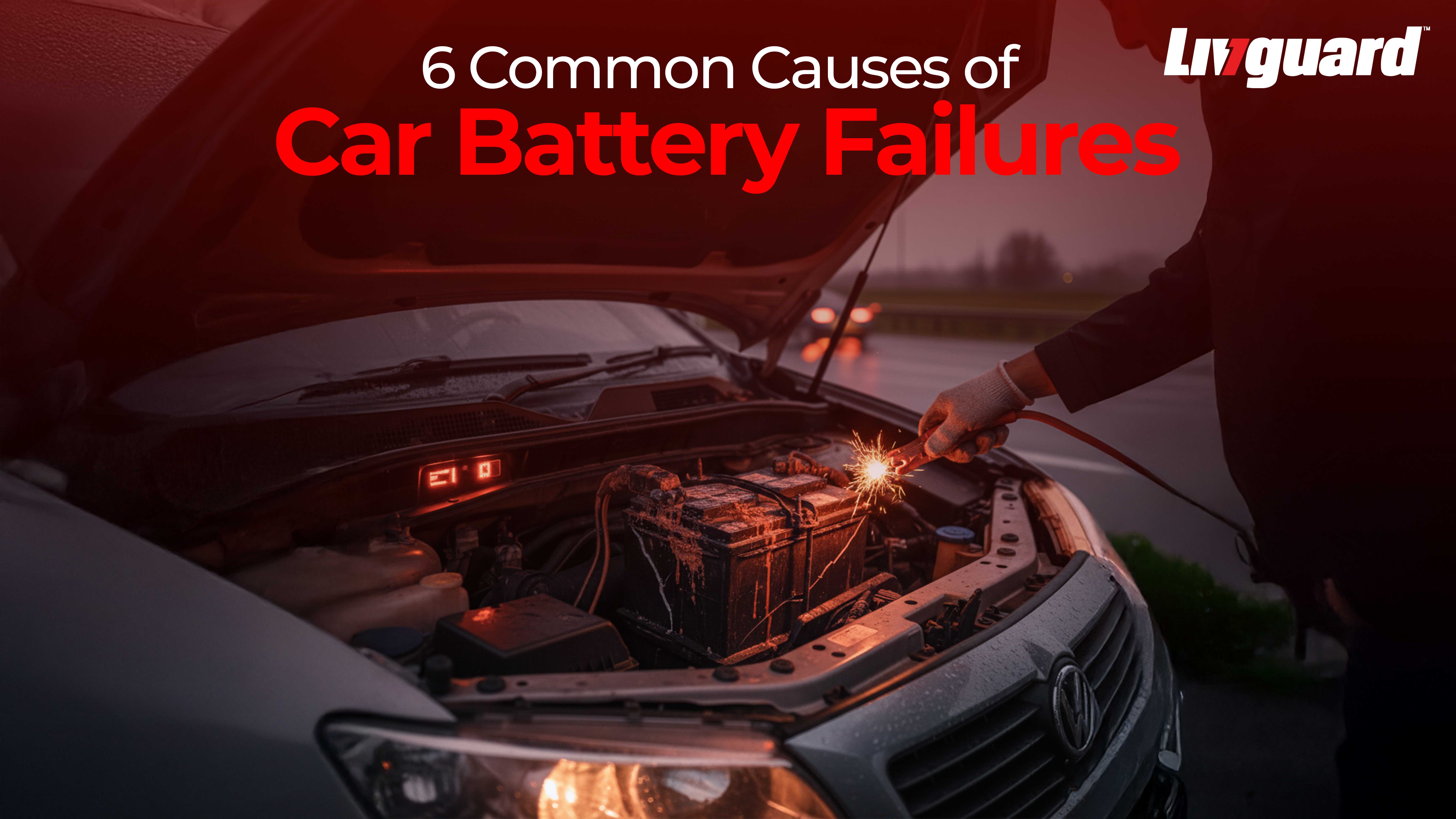
6 Common Causes of Car Battery Failures
| Sr. No. | Table of Contents |
|---|---|
| 1 | How to Prevent Car Battery Failures: Tips for Better Maintenance |
| 2 | Best Practices for Car Battery Care |
Our automobiles are our lifelines, and it’s tough to imagine our life without them. They are the most common mode of commutation for daily travellers. Mostly everybody must have experienced a common scenario at some point in life when we tried to switch on our car, and it failed to start. Be it our vehicle or a taxi; a battery always can fail at the most inopportune moments.
Do you still think that the battery is just a small part of an automobile? You will be surprised to know that a battery, though a small part of the framework, is the heart of our machine. So, for a critical part, we need to make an informed decision. We need to get into the depth of knowing the causes of car battery failures. It will be useful for us to understand the working of our car better and will help us in selecting the right battery next time.
1. Ageing
Everything on this earth is perishable, and so are our batteries. As time progresses, the internal resistance of the batteries increases, and ultimately it leads to battery failures.
2. Improper care
Our batteries need proper maintenance and care, even when they are not in use. Improper care is a fundamental reason for battery failures. One should read the manufacturer’s instructions about how to store and maintain the battery, when not in use.
3. Corrosion
Battery acid is corrosive. The battery terminals are the way the battery can get charged by the alternator. So, if the connections are all swamped up, the battery is not getting properly charged. One needs to clean the corrosion to improve the car’s ability to charge the battery.
4. Cold Weather
It is one of the most common causes of battery failure. Therefore, many people associate a dead battery with winter. As no one can control the weather, look out for the sign of a weak battery and make the required preparations.
5. Electric leakage
All batteries tend to lose electrical energy when not in use, known as self-discharge. It could be due to several factors like manufacturing practices, ageing, operating temperature, charge/discharge cycle etc.
6. Repeated Cycling
When a battery goes from fully charged to fully discharged repeatedly, it loses a lot of active materials from the positive plates. Thus, reducing its capacity and useful life.
The lifespan of a battery is limited, but it can be considerably shortened by these factors which tend to cause premature battery failures. The factors stated above are the most common causes of battery failures, and as a car owner, we can be aware of these factors. As a matter of fact, in Japan, battery failure is the most significant complaint among the car owners. A car is driven mostly on a congested road. Due to this, the batteries are never fully charged, and sulfation occurs.
How to Prevent Car Battery Failures: Tips for Better Maintenance
Car battery failure can be a hassle for everyone. Here is how to extend your car battery life and how to prevent car battery failure. These simple maintenance tips and regular checks can keep your battery working well and prevent you from getting stuck on the road.
1. Know How Old Your Battery Is
Car batteries do not last long. Most work for about three to five years. So you should check how old yours is. Then you can plan a replacement before it gives up. Do not wait until your car stops working.
2. Keep the Terminals Clean
Dirty terminals can stop your battery from working. It does not allow your battery to charge properly. You can clean it with baking soda and water and use a soft brush to clean it. Make it a habit to check and clean them.
3. Do not Let It Drain Completely
Your battery can have damages when you leave electronics on after turning off the engine. It will not work for a long time if you do this. So, always check that everything is off before leaving your car.
4. Watch for Electrical Issues
Sometimes your car can have problems starting. It means that your battery needs to be checked. Visit a mechanic to get this checked. It can damage your battery if you ignore any issues.
4. Protect It from Heat and Cold
Batteries do not like various temperatures. In cold weather, you can struggle to start your car. They can lose charge faster in hot weather. So try to park in the shade during summer and during winter, use a cover.
5. Get It Tested Regularly
You do not have to wait until your car refuses to start. Many service centres offer battery testing. It is a quick check that helps you know if your battery is in good shape or needs replacing soon.
6. Follow the Right Care Instructions
Each battery brand has its own care guide. Follow it for charging, cleaning, and storing your battery. Doing this helps you get the best performance and longer life.
Best Practices for Car Battery Care
Here are certain car battery maintenance tips to follow:
| What to Do | Why It Helps |
| Clean terminals | Keeps charging smooth |
| Avoid full discharge | Extends battery life |
| Test regularly | Spots early issues |
| Protect from heat and cold | Prevents damage |
| Follow the care guide | Keeps the battery healthy |
By following these your car will go a long way, ensuring you have a happy and reliable ride. reliable every day.
If your car battery is more than three years old and you live in a hot climate, then your battery is probably living on borrowed time. Abnormally slow cranking, especially on a cold day, is another good indication that your battery is going bad. Livguard automotive batteries are all about delivering the best experience in any road condition. They are designed for the extraordinary performance of your vehicle in all weather conditions. They provide high cranking power and best in class warranty to give a long-lasting and robust battery to its consumers. Livguard’s products are driven by innovative technology to achieve excellence in manufacturing and services.