7 Tips to Maintain an Inverter Battery
| Sr. No. | Table of Contents |
|---|---|
| 1 | Types of Inverter Batteries for Your Home |
| 2 | How to Choose the Right Battery for Your Home |
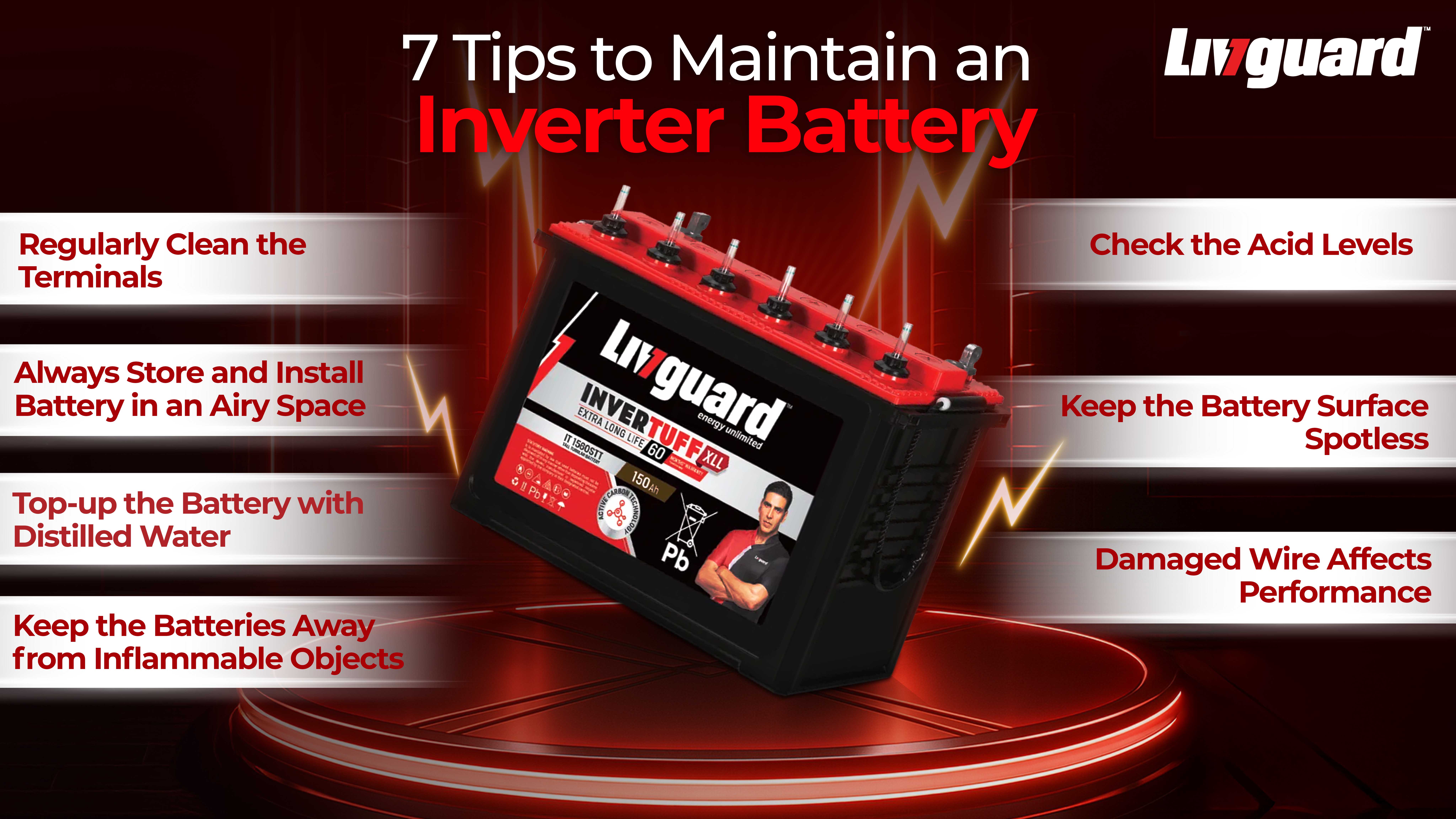
A battery is the core of a power backup system. It needs replacement twice or more in its lifetime depending upon its usage, performance, maintenance and upkeep. The battery gets old or worn out from exposure to heat and repeated charging and discharging. With a few maintenance tips and tricks, one can extend the life of a battery’s lifespan. Some of the easiest and quickest tips on how to maintain an inverter battery are:
1. Regularly Clean the Terminals:
It’s important to periodically check the terminals of the inverter battery and keep them clean from dust or worn-out rusty surfaces. Also, ensure that the water level is not below the minimal level.
2. Always Store and Install Battery in an Airy Space:
Airy and spacious location provides natural cooling air circulation to counter the inverter battery heating problem. Thus, cool and airy spaces are preferred for storing the inverter battery.
3. Top-up the Battery with Distilled Water:
Normal tap water and RO water should not be used for top-up as they contain dirt and other impurities that can shorten the battery life. Therefore, distilled water is preferred for battery top-up.
4. Keep the Batteries Away from Inflammable Objects:
To avoid disasters and fire mishaps, it is advisable to keep the inverter battery away from inflammable objects. The battery can catch fire through them.
5. Check the Acid Levels:
To check the acid levels, look at the float indicators. The acid level should be equal in all the cells for the proper working of the inverter battery. Also, ensure that the batteries are not overfilled. Doing otherwise can prove dangerous for its operation.
6. Keep the Battery Surface Spotless:
To ascertain the proper functioning of a battery, you should check for any deposition of dirt on its surface. If you find dirt, try to clean it with a dry cloth. This way, you will be able to keep the battery clean.
7. Damaged Wire Affects Performance:
Test the battery wires for any crimp, break, and insulation melt. Damaged wires reduce the battery output and also raises the risk of short circuits and other dangers in the house.
Types of Inverter Batteries for Your Home
Various inverter battery types affect backup time and maintenance needs. The efficiency also differs as you go for different options. Here are the common types for your homes:
1. Tall Tubular Battery
These batteries are best for homes with long-duration power cuts. These do not need much maintenance apart from occasional water top-ups. You can choose them if you require reliable power for many hours straight or need a battery that tolerates heavy usage.
They provide:
- Extended backup
- Robust and durable nature
- Resistance to high temperatures
2. Short Tubular Battery
These types are very suitable for homes that need just moderate backup requirements. The upkeep is minimal. The short tubular batteries can very well handle frequent charge cycles. These are just perfect if your power outages are shorter. And they are very apt for your use if you need a check between cost and performance.
They offer:
- Compact design
- Efficient performance
- Cost-effectiveness
3. Gel Inverter Battery
These are your best inverter battery types options if you are looking for maintenance-free operation. You do not need to top up water. They are just perfect for households that prefer easy solutions and continuous performance.
They offer:
- Fully sealed set-up that is safe
- Environmentally friendly
How to Choose the Right Battery for Your Home
Your power needs are the most important things that you must know before entering the selection process. Know the simple way to estimate it:
1. List Your Essential Appliances
Some appliances are very important to you that you can not do without them, even during a power cut. You have to list them and note their power consumption (in watts).
2. Estimate Backup Time
How to estimate home electrical load? Decide how many hours you want the battery to power your appliances. This will determine the required Ampere-Hour (Ah) capacity.
3. Use a Home Load Calculator
How to calculate home load? A home load calculator can simplify this process. It helps identify the right inverter and battery capacity without any guesswork. You just need to enter your appliance load and desired backup hours.
4. Consider Battery Type
- Tall Tubular: Long backup, sturdy, good for high load.
- Short Tubular: Moderate backup, compact, cost-effective.
- Gel: Maintenance-free, safe, and ideal for hassle-free operation.
5. Compare Lithium vs Lead Acid Inverter Batteries
- Lead Acid Batteries: Proven, cost-effective, reliable for most households, but heavier and require occasional maintenance.
- Lithium Batteries: Lightweight, longer lifespan, high efficiency, but costlier.
Key Takeaway: For most homes, lead-acid tubular or gel batteries provide the best combination of reliability, cost, and performance.
Livguard is a trustable brand when it comes to delivering safe, secure, durable and long-lasting inverters. We have a global presence envisioning furthermore to be a global leader in the industry of energy storage products like inverters and inverter batteries. Livguard is the pioneer in the field of manufacturing the best inverter batteries countrywide.We are the most trusted brand, and Livguard’s 150Ah batteries are well designed for extraordinary performance. We aim to achieve this by developing the ultimate quality product and highly satisfactory service. Visit our website to know about our wide variety of products and their buying details.