Inverter not Working? Find the Probable Reasons and Fixes
Introduction
An inverter plays a massive role in ensuring you have undisturbed access to power to run your equipment and appliances in case of an outage. However, the fact remains that inverters are, after all, machines, and they may stop working correctly for any malfunction. That is why it is important to look closely for any potential issues and fix them quickly to stop any further damages.
Although the reasons an inverter may stop working altogether may vary from one situation to another, here are a few of those with probable solutions. In this article, other than finding out the probable reasons for an inverter not working, we will also look at the different types of inverter for home use and how to go about choosing one.
Common Reasons an Inverter is Not Working
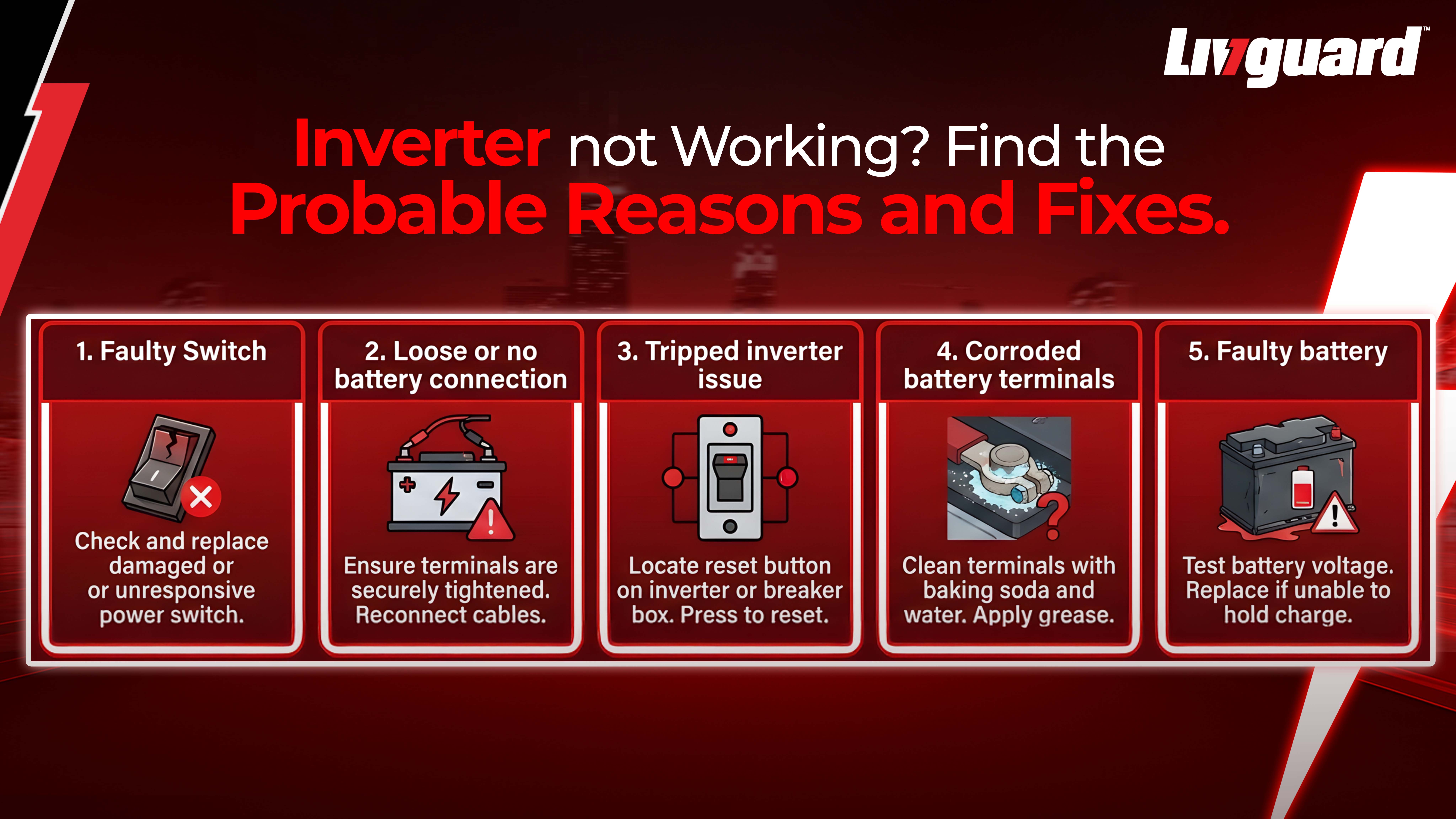
Faulty Switch
One of the most obvious reasons for an inverter not starting up or working correctly is a faulty switch. If that is the reason, the solution is simple. Fix the defective power switch by taking the help of a professional.
Loose or no battery connection
If the battery is not properly connected to the inverter, it may cause serious problems while functioning. Also, if it’s not connected, it is natural that the inverter won’t work.
Tripped inverter issue
Tripping may be a potential issue with an inverter. To fix the problem of the tripped inverter, press the ‘Reset’ button, and it should work. In case it does not, then the inverter may have any other issue. Sometimes, the solution is to replace it entirely with a branded, high-quality inverter with a good warranty span, excellent after service, and unmatched results.
Corroded battery terminals
Rusted or corroded battery terminals can shorten the battery’s life and prompt it and the inverter to stop working. Check the terminals. If signs of corrosion or rust are spotted, cleaning it carefully with a dry cloth should help.
Faulty battery
In some cases, an inverter can stop working or not work at its maximum potential because of a defective or weak battery. Using a battery to power up misfit applications, environmental conditions, overcharging and overcharging, lack of regular maintenance, age etc., could potentially render the battery ineffective. In case of a faulty battery, replace it immediately.
How to Troubleshoot Inverter Issues
If your inverter’s acting up, don’t panic. It’s frustrating, sure but most inverter problems aren’t as serious as they seem. Before calling a technician, check a few things yourself.
At times, there could be a few small issues that give rise to inverter problems. For example, the inverter isn’t working because a fuse has blown. Or it may happen that the plug got loose. In some cases, the battery cable has fallen out. Open the panel and take a look at everything.
Try these quick fixes:
- Look at the battery terminals. Clean off any rust and tighten them.
- Cut down the load. Unplug some devices and restart.
- Check the fuse or breaker. Change it if it’s blown.
- Give it a full restart. Turn off, wait a half-minute, then power on.
Different Types of Inverters for Home use
There are two types of inverters that you can find in the market for use in consumer applications. These are namely Pure Sine Wave Inverters and Moderate Sine Wave Inverters.
Pure Sine Wave Inverters: These inverters are good to be used for most applications. It is proven that pure sine wave power will lengthen a product’s lifetime. These inverters usually run much quieter, reducing the audible and electric noise in appliances. Using a pure sin inverter is beneficial in a number of ways.
Moderate Sine Wave Inverters: Moderate sine wave inverters are similar to the pure sine wave inverters but these usually are a cheaper alternative to the pure sine wave variant. These types of inverters don’t require the complicated system needed to smooth and render the output waveform.
When it comes to finding an inverter for home, the first step is to measure the power usage by your appliances and get an estimate of your home’s energy demand during a power outage. Then, you need to understand the capacity up to which an inverter can operate normally. You can find inverters with different sizes suiting your needs. Accordingly, you should choose an appropriately sized battery. When buying an inverter, and inverter battery, always select a product from a trusted brand.
How to Choose the Right Inverter and Battery
If you’ve been constantly dealing with inverter problems, maybe it’s time to upgrade. Choosing the right inverter and battery combo saves a lot of trouble later. Here’s what to keep in mind:
- Know your power needs. Add up the wattage of your essentials.
- Pick the right battery size. Bigger batteries mean longer backup.
- Choose the inverter type wisely. Pure sine wave for electronics, square wave for basics.
- Check service and warranty. Go with a brand that actually helps when something goes wrong.
A few smart choices today will save you from repeating the same “inverter not working” routine every few months.
Maintenance Tips to Extend Inverter Life
- Regularly Clean the Terminals: It’s important to periodically check the terminals of the inverter battery and keep them clean from dust or worn-out rusty surfaces. Also, ensure that the water level is not below the minimal level.
- Always Store and Install Battery in an Airy Space: Airy and spacious location provides natural cooling air circulation to counter the inverter battery heating problem. Thus, cool and airy spaces are preferred for storing the inverter battery.
- Top-up the Battery with Distilled Water: Normal tap water and RO water should not be used for top-up as they contain dirt and other impurities that can shorten the battery life. Therefore, distilled water is preferred for battery top-up.
- Keep the Batteries Away from Inflammable Objects: To avoid disasters and fire mishaps, it is advisable to keep the inverter battery away from inflammable objects. The battery can catch fire through them.
- Check the Acid Levels: To check the acid levels, look at the float indicators. The acid level should be equal in all the cells for the proper working of the inverter battery. Also, ensure that the batteries are not overfilled. Doing otherwise can prove dangerous for its operation.
- Keep the Battery Surface Spotless: To ascertain the proper functioning of a battery, you should check for any deposition of dirt on its surface. If you find dirt, try to clean it with a dry cloth. This way, you will be able to keep the battery clean.
- Damaged Wire Affects Performance: Test the battery wires for any crimp, break, and insulation melt. Damaged wires reduce the battery output and also raises the risk of short circuits and other dangers in the house.