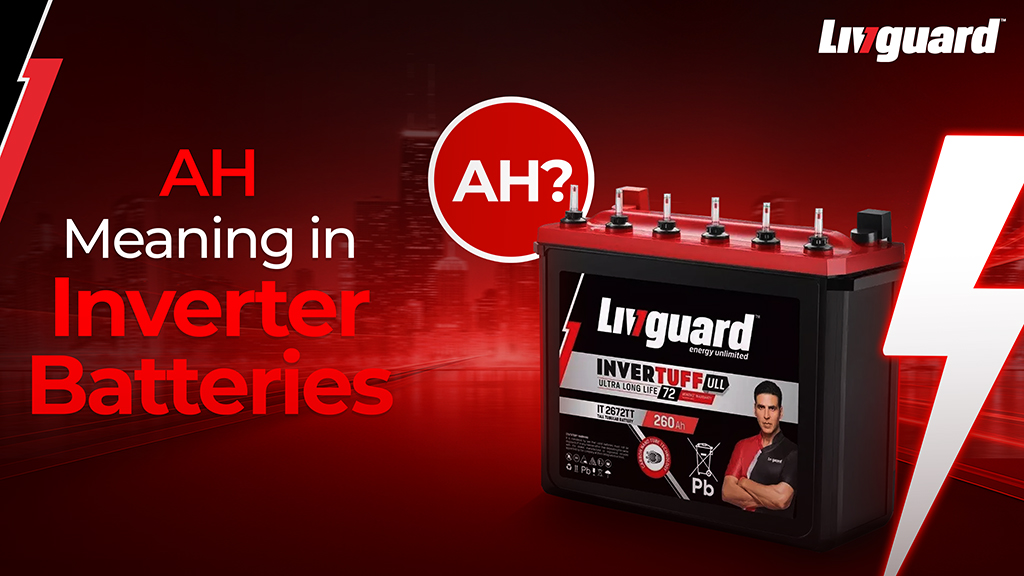
Ah Meaning in Inverter Batteries: Formula, Examples, and More
If you have ever shopped for an inverter battery, you must have seen numbers like 100Ah, 150Ah, or 200Ah on the labels. But have you stopped and asked yourself – what do they actually mean?
Do not worry, many have the same problem as you do! Most people just assume “higher Ah is better” without really knowing why. Why not just get to the core and understand
- What is Ah in inverter battery
- How it is calculated
- How does it impact your power backup?
Read on to know all about it!
Breaking Down “Ah” in Simple Terms
“Ah” represents Ampere hour. Here, it shows the amount of charge a battery can hold and supply. A follows: an easy way to understand it is if you consider your battery as a water reservoir for some time. Now, the “Ah” rating here would tell the volume of water it can hold. So, a battery of capacity 100Ah can give:
- 1 ampere of current for 100 hours, or
- 10 amperes for 10 hours, or
- 50 amperes for 2 hours.
So, higher Ah means more stored energy, which usually means more backup time.
Ah, Amps, Volts, and Watts – Making Sense of It
Let us know a bit about electric current ampere and voltage first.
Ampere (A) → Think of it as the amount of water flowing in the pipe. More amps = more electricity flowing.
Volt (V) → This is like the pressure in the pipe that pushes the water forward. Higher volts = stronger push.
Together, they decide how much work electricity can do.
You multiply the two to find power in watts:
Power (W)=Ampere (A) Volt (V)
So, this is the formula for ampere to watt! Ampere and volt together tell you how powerful your battery really is.
Formula to Calculate Battery Capacity (Ah)
A standard formula is the best thing you can use when choosing the right ampere battery:
Battery Capacity (Ah)=Power Requirement(W) Backup Time(hrs)Battery Voltage(V) Efficiency
Where:
- Load = sum of all appliance wattages
- Backup Time = how many hours you want power during cuts
- Voltage = usually 12V for most inverter batteries
- Efficiency = around 80–90%
Example: Choosing the Right Ah
Let us do a quick calculation.
- Load: 500W (lights, fans, router, fridge)
- Backup time: 3 hours
- Battery voltage: 12V
- Efficiency: 85% (0.85)
Battery Capacity (Ah)=500 312 0.85147 Ah
So you would need at least a 150Ah battery to run this load for 3 hours. That is how you pick the correct ampere hour battery.
And if maths is not your thing, the Livguard Load Calculator can do the work for you in seconds.
Factors That Affect the Ah Requirement
| Factor | Impact on Ah Requirement |
| Load size | More appliances = higher Ah |
| Backup duration | Longer hours = bigger battery needed |
| Battery type | Lithium batteries are more efficient than lead-acid ones |
| Efficiency losses | Energy is always lost in charging/discharging |
Practical Tips for Picking the Right Option
- Bigger is not always better – A 200Ah battery is great, but why spend more if your needs are small?
- Match the inverter and battery properly – Not every inverter can handle large batteries.
- Think about future needs – Plan for a slightly higher Ah if you will add appliances.
- Brand matters – Reliable brands like Livguard ensure longer life and better efficiency.
Ah Ratings in Real Livguard Products
Livguard offers a wide range of inverter batteries suited for different homes:
- IT1048st (100Ah) – Perfect for smaller setups (fans + lights).
- IT1642tt (160Ah) – Great for medium households.
- IT2048tt (200Ah) – Designed for larger homes or longer backup needs.
This way, you can pick the right inverter batteries without guesswork.
Conclusion
Now you know exactly what is Ah in inverter battery and why it matters. It is not just a random number because it tells you how long your appliances can keep running when the lights go out.
By using the formula, considering your load, and balancing budget vs need, you can easily find the right ampere battery for your home.
So next time you see “150Ah” or “200Ah” on a battery, you will know exactly what it means.