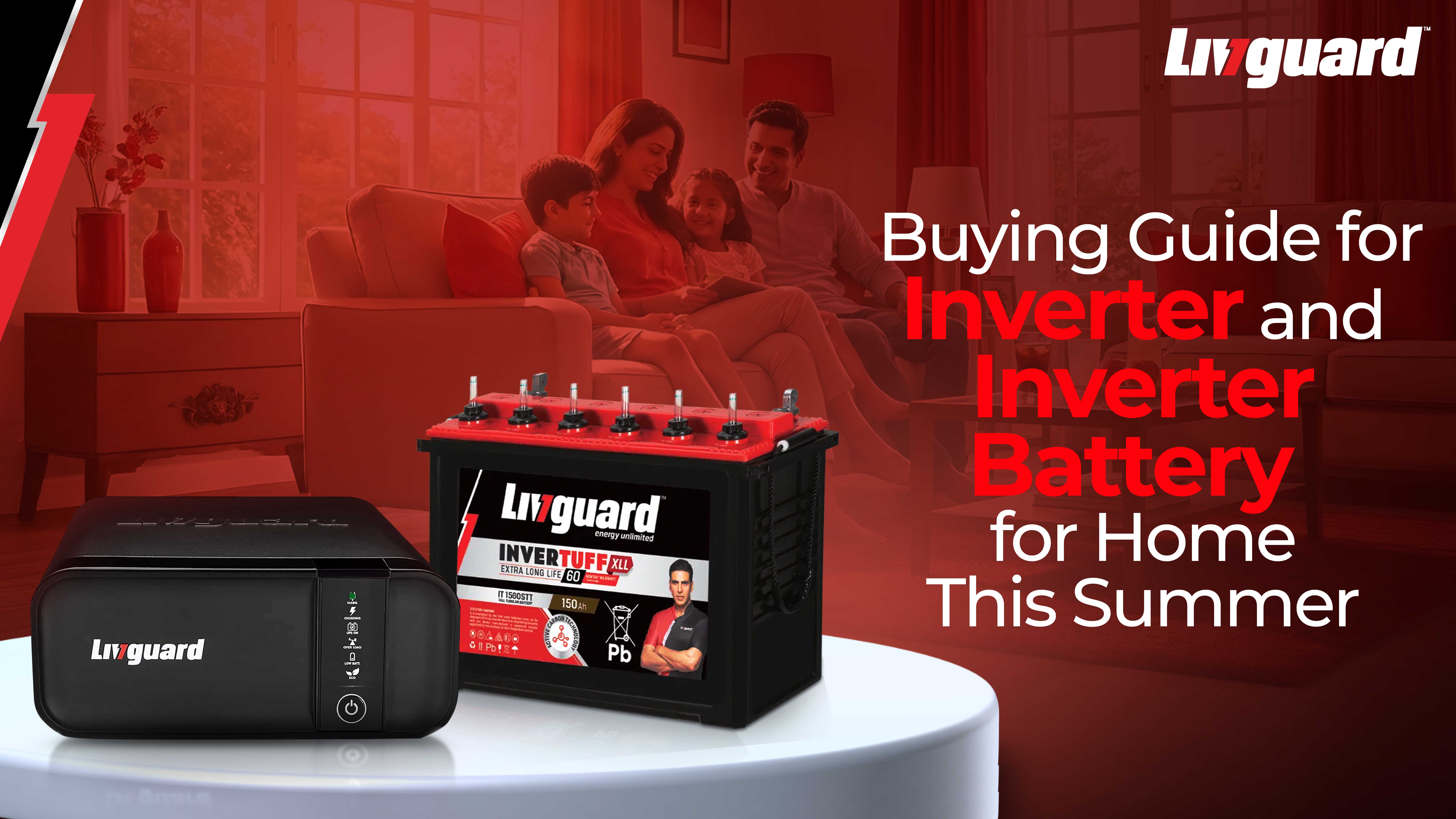
Buying Guide for Inverter and Inverter Battery for Home This Summer
| Sr. No. | Table of Contents |
|---|---|
| 1 | Calculate your power requirements for an inverter |
| 2 | Inverters or UPS |
| 3 | Battery |
| 4 | Other Options |
| 5 | Maintenance-free batteries |
| 6 | Batteries from inverter manufacturers: |
Scorching summers are here in full swing, and so are power cuts. We all will agree that inverters are the most demanded products of the summer season. So, if you are planning to buy or replace your old inverter with a new one, then instead of being trapped in the marketing gimmicks, be your own educator. Understand some basic facts about inverters and inverter batteries, before going for the best buy.
1. Calculate your power requirements for an inverter:
An inverter is not a generator and has its own limitations. You can’t power and run the complete household with a normal inverter.
- Wattage rating of typical home appliances: Decide the appliances and gadgets you want to run on the inverter with their power consumptions.
- Starting power and running power: Starting and running power requirements of all electric appliances are different. Some appliances like the refrigerator, washing machine etc. take almost double power to start as compared to the normal running power.
- Find the VA rating: It is the voltage and current supplied by the inverter to the equipment. If the inverter operates with 100% efficiency, this means that the power requirement of the appliances and power supplied by the inverter is the same. But this is ideally not possible, and this is known as the power factor of an inverter. Thus, the combination of your power requirement and inverter’s power factor decides the VA ratings of an inverter.
2. Inverters or UPS:
Functionally both UPS and inverter does the same job, i.e. converting DC into AC in case of power failures. But for a home, the backup power requirement is higher. UPS cannot supply that much power and only support it for a few minutes. Therefore, it is best to buy an inverter.
3. Battery:
The life and performance of an inverter are very much dependent on battery quality. The capacity of a battery is expressed in terms of Ampere Hour (Ah). It indicates:
- No of back up hours
- Power requirement
- Voltage of the battery
Types of Inverter Batteries
Don’t let power cuts catch you off guard! Choose the right inverter battery. There are several types of inverter batteries. Each is for specific needs and usage patterns. Here is a quick look at the best inverter battery types for homes in India.
| Type | Best For | Features | Pros | Cons |
| Flat Plate Battery | Areas with short, frequent power cuts | Basic, budget-friendly battery | Affordable, easily available | Needs frequent water top-ups; shorter life (3–4 years) |
| Tubular Battery | Areas with long power outages | Tall design with deep charge cycles | Long life (5–8 years), powerful performance, ideal for Indian summers | Slightly costlier than a flat plate one. |
| Gel Inverter Battery | Homes wanting maintenance-free use | Uses gel instead of liquid electrolyte | No water topping required, safe and eco-friendly | Higher upfront cost |
If you are stuck between lithium vs lead acid inverter batteries, let us understand them, too. Lithium ones are lightweight. They charge fast and last long. But they come with a higher price tag. Lead acid batteries (flat or tubular) are budget-friendly and powerful. All they need is some regular care.
Tip: For most Indian homes, tubular or gel batteries strike the right balance between efficiency, performance, and cost.
How to Calculate Home Load
Many homeowners struggle with how to estimate home electrical load for an inverter. Do not worry, it is simpler than it sounds! The idea is to find out how much power your essential appliances need during a power cut.
Let’s say you want to run the following essentials during a power cut:
- 3 LED bulbs (12W each)
- 2 ceiling fans (75W each)
- 1 television (100W)
The easy steps are as follows:
1: Add Up the Power Consumption
= (3 × 12) + (2 × 75) + 100
= 36 + 150 + 100
= 286 watts
2: Calculate the Required VA Rating
Use the formula:
VA = Power Requirement ÷ Power Factor
Assuming a power factor of 0.8,
VA = 286 ÷ 0.8 = 357.5 VA
3: Choose a Slightly Higher Capacity
Round up to the nearest practical value. For instance, the example that we have at hand, we can take it to be 400 VA. Such an inverter would be ideal for this setup. It will keep things running smoothly and protect your system from overloading.
Still unsure? Try the Livguard Home Load Calculator. It is our quick and easy online tool to help estimate your home’s electrical load in minutes.
Understanding Ah and VA in Batteries
When you go out looking for an inverter battery, you will often come across two key terms: Ah (Ampere-Hour) and VA (Volt-Ampere). Understanding these helps in choosing the right Ah and VA for your battery.
| Term | Meaning | Use in Real Life |
| Ah (Ampere Hour) | Measures how much charge a battery can store. | Tells you how long your inverter can run. For example, a 150Ah battery can power basic appliances for about 5–6 hours. |
| VA (Volt Ampere) | Indicates the inverter’s total power capacity. | A higher VA rating means the inverter can handle more load at once. |
So, what is Ah in battery capacity? It is simply the measure of how much energy your battery can supply over time. If your home needs 170 watts for 6 hours, a 150Ah battery should serve you well.
Therefore,
- Ah = Duration of backup
- VA = Load-handling capacity
When selecting, balance both values for optimal backup time and performance.
4. Other Options:
Automotive batteries are not suitable for home requirements: Lead-acid batteries used for automotive purpose are termed as “high cycle” lead-acid batteries while the requirement of the inverter is totally different. They require a “deep cycle” battery to provide continuous power.
5. Maintenance-free batteries
These batteries are sealed lead-acid batteries which do not require topping up or additional ventilation. But the life of maintenance-free batteries is comparatively low, and the cost is comparatively high.
6. Batteries from inverter manufacturers:
It is always advisable to go for a trusted brand for both inverter and inverter batteries. If you are getting this under a reliable name, one should not leave such an opportunity. It always helps with after-sales support and maintenance issues.
Livguard can be your saviour in this aspect, as our reliable brand provides the best inverter and inverter batteries for your home backup requirements. Our robust, sturdy and long-lasting products come with a good warranty span and unmatched results. We are a pioneer in the field of manufacturing, trusted inverter and inverter batteries.