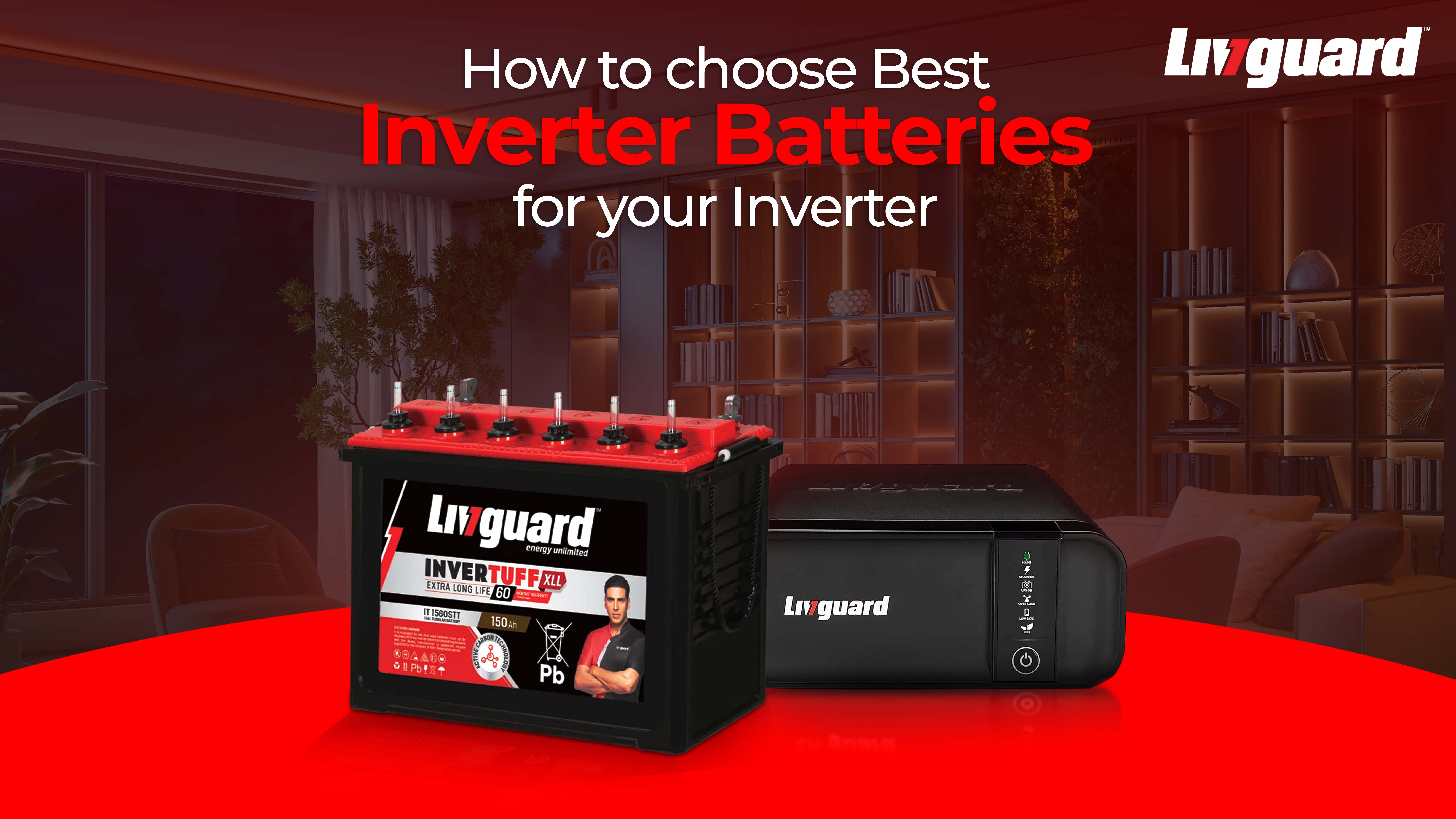
How to choose Best Inverter Batteries for your Inverter
With the summers approaching, most Indian households are affected by the continuous power cuts and voltage surges. People look out for various trusted ways of defeating these issues, and reliably rely on inverters and inverter batteries. What’s essential is that the batteries you need will have to be powerful enough to provide the required power for a few hours straight.
Thus, while choosing or replacing the inverter and inverter batteries for your household, one needs to look for or be precise about various factors and requirements. Some of them are stated below.
Steps to Choose The Best Inverter Battery for Home
The challenge one faces in India is making the right choice of choosing the inverter and the battery that breathes life into it. People often struggle to make the correct decision and explore various options before finalizing one. Many also wonder which is the best inverter battery for home, especially with so many brands and technologies available. Let’s see some of the factors one must consider while making the right choice for buying the inverter battery.
Consider your power requirement:
This is the most basic thing to consider while deciding the inverter in your home. In simple words, you have to decide the appliances and gadgets you want to run on this reliable power source at the time of power failure.
Find the VA rating of your inverter:
VA stands for the volt-ampere rating. It is the voltage and current supplied by the inverter to the equipment. If the inverter operates with 100% efficiency, this means that the power requirement of the appliances and power supplied by the inverter is the same. But this is ideally not possible, and this is known as the power factor of an inverter. Thus, the combination of your power requirement and inverter’s power factor decides the VA ratings of an inverter.
Choice of battery:
The battery is the heart of an inverter. It works like a backbone for it. The life and performance of an inverter are very much dependent on battery quality. The battery capacity is measured by the number of hours it can run the appliances. It is measured in Ampere hours (Ah). A simple calculation of battery capacity is done with the power requirement, number of backup hours required and the voltage of the battery. This simple calculation will save you from any misleading information.
Choice of place from where you’ll buy the battery
You can choose to buy from local manufactures or you can buy from a trusted online store.
Various ways to maintain your inverter battery: It’s important to understand the various ways and tips to maintain your inverter and inverter batteries to optimize their performance and increase durability.
Things to Keep in Mind While Choosing Your Inverter Battery
Once you have taken care of all the steps for buying an ideal inverter battery for your household, you should look out for various other things while making the right choice. Such as:
Battery Capacity:
If an inverter battery can provide one ampere of current for one hour, its capacity is 1Ah. If the battery can provide one ampere of current for 100 hours, the capacity is 100Ah. You can calculate the inverter battery capacity needed for your home by multiplying the load requirements with hours of backup you need.
Power Density:
It is the maximum rate of energy discharged per unit mass. The battery you choose should be equipped with more power density.
Durability:
Try to go for a reliable and trusted brand that ensures a longer life span for the battery. It is dependent on the stability of the energy density and power density of the battery.
Safety:
Certain battery components break down at high temperatures. Therefore, one should choose a battery that can perform better at a higher temperature.
Cost-Effective:
One should look out for batteries that are cost-effective and give great performance. The performance of the battery should complement its value.
Energy Density:
This is the energy that can be stored per unit mass. The battery should be energy-efficient.
Battery Types:
There are three types of inverter batteries that can be installed at home. These are:
- Lead Acid Batteries: These are the most common types of inverter batteries available in the market. They are rechargeable in nature and produce large amount of current. These are very light in weight and are economical in nature.
- Maintenance Free Batteries: These are sealed lead acid batteries that do not require electrolyte level check and topping up. They are safer than normal lead-acid batteries but cost more.
- Tubular Batteries: These are the most popular and efficient inverter batteries. They have a complex design, great efficiency, longer operational life and low maintenance.
The Various Tips to Increase Life of Inverter Batteries
Regularly Clean the Terminals:
It’s important to periodically check the terminals of the inverter battery and keep them clean from dust or worn-out rusty surfaces. Also, ensure that the water level is not below the minimal level.
Always Store and Install Battery in an Airy Space:
Airy and spacious location provides natural cooling air circulation to counter the inverter battery heating problem. Thus, cool and airy spaces are preferred for storing the inverter battery.
Top-up the Battery with Distilled Water:
Normal tap water and RO water should not be used for top-up as they contain dirt and other impurities that can shorten the battery life. Therefore, distilled water is preferred for battery top-up.
Keep the Batteries Away from Inflammable Objects:
To avoid disasters and fire mishaps, it is advisable to keep the inverter battery away from inflammable objects. The battery can catch fire through them.
Check the Acid Levels:
To check the acid levels, look at the float indicators. The acid level should be equal in all the cells for the proper working of the inverter battery. Also, ensure that the batteries are not overfilled. Doing otherwise can prove dangerous for its operation.
Keep the Battery Surface Spotless:
To ascertain the proper functioning of a battery, you should check for any deposition of dirt on its surface. If you find dirt, try to clean it with a dry cloth. This way, you will be able to keep the battery clean.
Damaged Wire Affects Performance:
Test the battery wires for any crimp, break, and insulation melt. Damaged wires reduce the battery output and also raises the risk of short circuits and other dangers in the house.
Inverter Battery Shopping for Home
Livguard can be your saviour in this aspect, as our reliable brand provides the best inverter and inverter batteries for your home’s backup requirements. Our robust, sturdy and long-lasting products come with a good warranty span and unmatched results. We are a pioneer in the field of manufacturing, trusted inverter and inverter batteries.
Livguard has a global presence envisioning furthermore to be a global leader in the industry of energy storage products. We aim to achieve this by developing the ultimate quality product and highly satisfactory service. Next time you visit your local dealer, make sure to check out Livguard batteries for a reliable, long-lasting power solution that keeps your home running smoothly.