Single Phase vs Three Phase Inverters: Know the Differences
Have you ever thought about why your home inverter runs your lights and fans smoothly, but factories need those giant, heavy-duty machines? The answer lies in the type of inverter they use. The single phase inverter and the 3 phase inverter are very important names in this context. How are they different from each other? A person need not be an engineer to understand it all.
We will be able to understand the main differences between the two in the simplest way possible.
What is a Single Phase Inverter?
A single phase inverter is like the friendly neighbour of the inverter family. It takes DC power (from a battery or solar panels) and converts it into AC power using a single sine wave. This is the same kind of electricity most homes use.
Where is it used?
- Homes
- Small shops
- Small office setups
The option is simple, affordable, and works smoothly for most households.
For example, Livguard’s single phase inverters paired with 100Ah–160Ah inverter batteries are perfect for homes where the load is fans, lights, a TV, and maybe a fridge.
What is a Three-Phase Inverter?
Now imagine you are running a factory with dozens of machines. Here comes the 3 phase inverter, the powerhouse. Unlike single-phase, it works with three sine waves, each shifted by 120 degrees. This ensures smoother power flow and stability, even with heavy machines.
Where is it used?
- Large industries
- Commercial spaces
- Electric vehicle charging stations
Livguard also provides heavy-duty solutions for commercial use, making sure power interruptions never bring work to a halt.
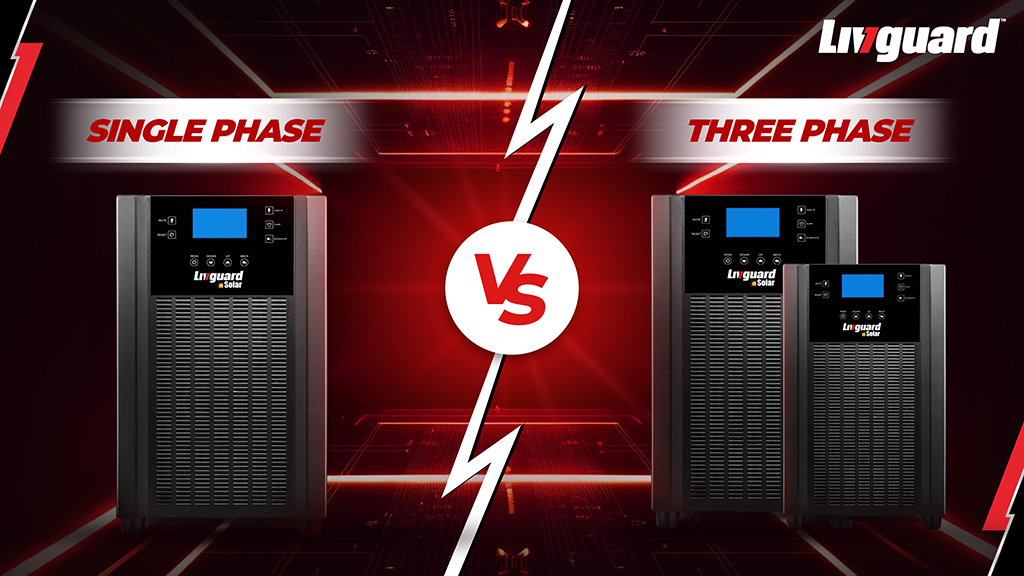
Single Phase vs Three Phase Inverters – Quick Comparison
Here’s a simple side-by-side view:
| Feature | Single Phase Inverter | 3 Phase Inverter |
| Working | Converts DC to AC using one sine wave | Converts DC to AC using three sine waves |
| Power Output | Lower, suitable for homes | Higher, suitable for industries |
| Voltage Stability | May fluctuate | More stable |
| Efficiency | Less efficient under heavy loads | Highly efficient with heavy loads |
| Cost | Cheaper | More expensive |
| Applications | Homes, small shops | Factories, commercial |
| Scalability | Limited | Highly scalable |
| Maintenance | Easier | Needs experts |
When Should You Choose Which?
- If your needs are basic household power backup (fans, lights, TV, router) → go for a single phase inverter.
- If your needs are heavy machinery, industrial use, or high load backup → the 3 phase inverter is the right choice.
Tip: Livguard offers inverters and inverter batteries that suit both residential and industrial needs. You can check their load calculator to make an informed decision.
Special Case: Converting Between the Two
Sometimes people wonder: “Can I upgrade from single-phase to three-phase?”
The answer: Yes, you can. Devices like a single phase to three phase inverter or single phase to three phase converters make this possible. They let you run three-phase equipment even when only a single-phase supply is available. This is useful in semi-commercial setups or areas where the utility doesn’t provide three-phase supply.
Factors to Consider Before Buying
- Load Requirement – List out appliances or machines you need to power.
- Backup Time – How many hours do you expect the inverter to run?
- Energy Efficiency – Check the inverter efficiency percentage.
- Scalability – Can the inverter handle more load in the future?
- Brand and Support – Livguard is known for strong service support and reliable inverter batteries.
Conclusion
The single phase inverter and the three phase inverter are designed for different needs. Homes and small offices work perfectly with single-phase models, while factories and commercial setups thrive on three-phase.
The key is not which one is “better,” but which one is “better for you.” And with Livguard’s wide range of inverters and inverter batteries, you’ll always find a match.