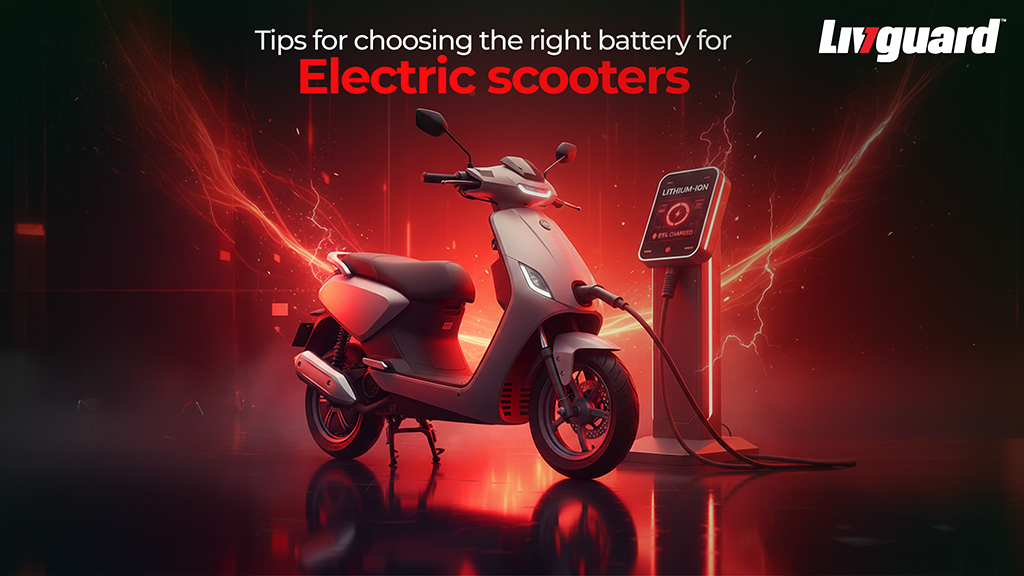
Tips for Choosing the Right Battery for Electric Scooters
| Sr. No. | Table of Contents |
|---|---|
| 1 | Quick Checklist (Use This Before Buying) |
| 2 | Livguard’s Offerings for Electric Scooter Batteries |
| 3 | Final Takeaway |
If you’ve ever searched for which battery is best for electric scooter, you already know how confusing the answers can get. Specs, chemistries, connectors, voltage, everything feels technical. But your scooter’s battery is not a “technical accessory.” It’s the heart of the entire ride. Range, pickup, charging time, and even long-term maintenance depend on it.
So let’s break it down. Simple. Practical. And focused on helping you pick the right pack without getting lost in technicalities.
1. Start with the Battery Chemistry
This is where most riders trip. Battery chemistry decides how your scooter feels on the road.
Lithium-ion is the default winner. It is light. It holds more energy. It charges fast. And it lasts longer. It’s also the answer to the biggest question: which battery is best for electric scooter, because nothing else offers the same balance of performance and lifespan.
A typical Li-ion pack lasts 300–800 cycles. For city scooters, that’s easily 2–4 years depending on use.
Then there is the lead acid battery for electric scooter. Cheap, but heavy. It drains fast, hates heat, and ages early. OK for budget retrofits, but not for anyone who wants range and reliability. If you ride daily, this is not the lane you want to be in.
Some scooters use Li-Po (super light, higher punch), but it needs strict temperature care. Urban riders usually stick to Li-ion for everyday practicality.
2. Check Voltage and Capacity (This Decides Speed and Range)
Once chemistry is sorted, match the voltage and capacity to your scooter.
Voltage = Power and speed.
Most electric scooter battery specifications fall into 36 V, 48 V, or 60 V. Higher voltage means more torque and better acceleration.
If your scooter originally came with 48 V, stick to 48 V. Don’t go higher unless the controller can handle it.
Capacity (Ah/Wh) = Range
To keep it simple: Wh = Voltage × Ah
Higher Wh = more kilometers.
But keep your choice practical. More Wh also means more weight. If you climb stairs with your scooter or frequently carry it on public transport, stay close to the original pack weight. Think of capacity as your fuel tank; bigger feels great, but only if you can carry it comfortably.
3. Watch the Weight–Range Balance
A bigger battery gives longer rides. But every extra Ah adds grams. Go too heavy, and you’ll feel it in acceleration, handling, and portability.
A good rule: Stay within 1–1.5 kg of your scooter’s stock battery weight unless you truly need the extra range.
Daily office commuters usually don’t. Delivery riders often do. Your riding pattern decides this choice not the internet.
4. Understand the Discharge Rate (C-Rate)
This one sounds technical but it isn’t.
Your motor demands a certain current. Your battery must be able to supply it continuously.
Here’s an easy rule: Continuous current ≥ Motor wattage ÷ Battery voltage
Example:
A 500 W motor with a 36 V battery needs at least 14 A continuous output. If the battery’s BMS can’t handle it, the scooter will feel weak and might cut out on inclines.
So when people ask which battery is best for electric scooter, the correct answer always includes:
“Pick one whose discharge rating matches your motor.”
Ignore this, and even a high-capacity battery will disappoint.
5. Confirm the Size and Connector Type
This step saves you from headaches later.
Measure the old battery. Length × width × height. Your new pack must fit exactly or the deck cover won’t close.
Now look at the connector. Scooters typically use XT60, T-plug, coaxial pins, or proprietary sockets. Avoid adapters unless you really know what you’re doing. Poor connectors heat up fast and can fail mid-ride.
The safest bet? Buy from brands or vendors offering plug-and-play packs for your scooter model. No rewiring. No surprises.
6. Look for a Good BMS and Temperature Rating
A battery is only as smart as its BMS.
A solid BMS protects against:
- Over-charge
- Over-discharge
- Short circuits
- Temperature spikes
Good packs clearly mention their operating temperature range. A typical high-quality range looks like:
- Charge: 0°C to 45°C
- Discharge: -20°C to 60°C
If you ride in Indian summers, don’t skip this. Heat kills batteries faster than anything else.
7. Buy Branded Cells Only
Branded cells cost more. But they are safer, more consistent, and predictable. Look for well-known automotive-grade manufacturers.
Cheaper no-name batteries often inflate their Ah rating. A “25 Ah” unbranded pack may perform worse than a 15 Ah branded one.
If you’re deciding which battery is best for electric scooter, think long-term. A slightly higher upfront cost saves more over the battery’s lifespan.
8. Expect a Break-In Period
Even the best battery for electric scooter performance doesn’t hit peak range on day one. Li-ion packs settle after 20–25 full cycles.
So don’t judge your new range too early. Ride normally for the first 10–15 days. Let the cells stabilise naturally.
Quick Checklist (Use This Before Buying)
- Chemistry: Li-ion preferred
- Voltage: Must match original
- Capacity: Highest Wh within your comfort weight
- Discharge Rate: Meets motor requirement
- Size: Same as original
- Connector: Exact match
- Cells: Branded only
- Vendor: Reputable or scooter-specific
Follow this, and you’ll rarely go wrong.
Livguard’s Offerings for Electric Scooter Batteries
Livguard offers two broad battery families. And if you’re searching for which battery is best for electric scooter, these give a solid starting point.
1. Lithium-Ion Packs
Purpose-built for modern electric scooters. 48 V options in the 20–30 Ah range.
High energy density. Active BMS. Fast charging. IP-67 sealed. Offered mainly through OEM partnerships and authorised e-mobility dealers.
2. MoRide Lead-Acid Series
These are not for electric scooters. They are for petrol scooters with electric start. Still listing them helps avoid confusion since many online results mix both segments.
If you ride an actual e-scooter, stick to lithium. Lead-acid is only for old-school ICE scooters.
Final Takeaway
Choosing the right battery is simple when you break it down. Start with chemistry. Match voltage. Pick the right Wh. Check discharge capability. Keep connectors and dimensions exact. Choose branded cells. And buy from a reliable dealer.
You now know exactly which battery is best for electric scooter based on your riding habits not vague online opinions.
Your battery decides how your scooter behaves every single day. Pick right, and the ride feels effortless. Pick wrong, and everything feels sluggish.